Close
India’s transition towards cleaner mobility is gaining momentum. Electric vehicles (EVs) are expanding across segments, while natural gas and renewable gases continue to offer practical solutions for reducing emissions and supporting the country’s growing transportation needs.
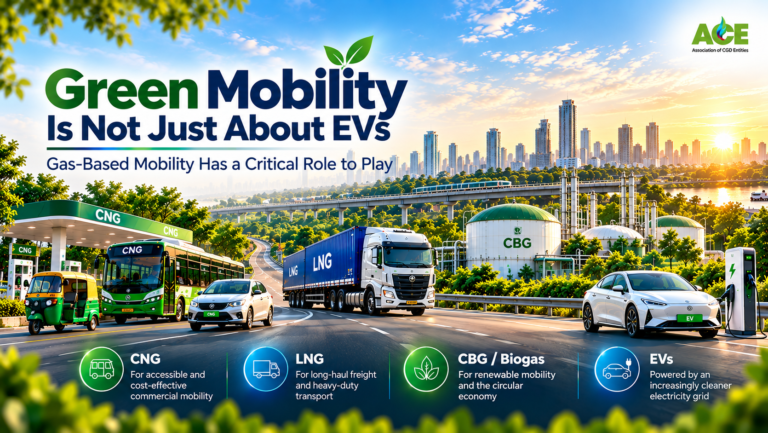
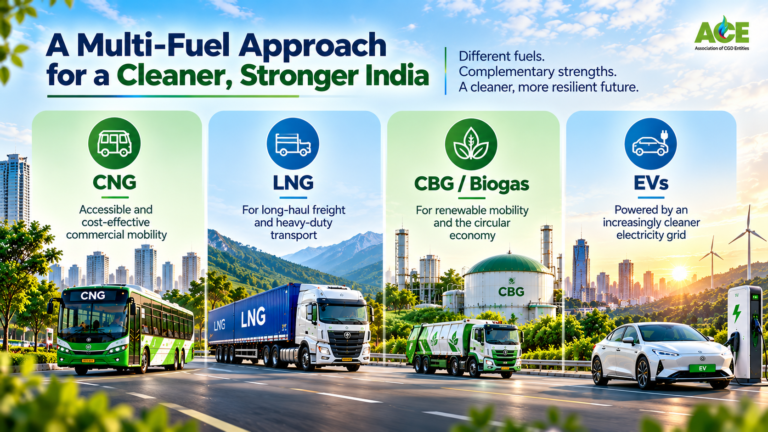
However, the road to sustainable mobility does not depend on a single technology. A balanced approach that combines electric mobility, Compressed Natural Gas (CNG), Liquefied Natural Gas (LNG) and Compressed Biogas (CBG) can help India accelerate decarbonisation while strengthening energy security and improving the affordability of transportation.
India’s transport sector serves diverse requirements, from daily urban commutes and public transportation to long-distance freight and commercial logistics. Each segment has different operational needs, infrastructure requirements and cost considerations.
While EVs offer significant opportunities for reducing tailpipe emissions, particularly when supported by a progressively cleaner electricity grid, gas-based fuels can complement electric mobility in segments where they offer practical advantages.
A technology-neutral approach allows each solution to contribute where it delivers the greatest value, rather than relying exclusively on one pathway.
Compressed Natural Gas (CNG) has an established presence in India’s urban transportation ecosystem. Its refuelling infrastructure and operating economics make it a practical option for taxis, buses, three-wheelers and light commercial vehicles.
CNG can support accessible and cost-effective commercial mobility, particularly in areas where refuelling networks are well developed. It also offers an opportunity to reduce certain pollutants compared with conventional petrol and diesel vehicles, depending on the vehicle and operating conditions.
Liquefied Natural Gas (LNG) offers potential for long-haul freight and heavy-duty transportation, where vehicle range, payload capacity, refuelling time and operational efficiency are important considerations.
As India’s logistics and freight requirements grow, LNG may complement other transportation technologies in suitable applications. Its wider adoption will depend on the development of refuelling infrastructure, vehicle availability, fuel economics and lifecycle emissions performance.
Compressed Biogas (CBG), produced by upgrading biogas generated from organic waste, agricultural residues and other suitable feedstocks, creates an important link between waste management, renewable energy and transportation.
CBG can support the circular economy by converting waste into a useful energy resource, while creating opportunities for rural enterprises and local value chains.
When produced sustainably, it can contribute to lower lifecycle emissions and reduce dependence on conventional fossil fuels. Initiatives such as the Government of India’s GOBARdhan programme can help strengthen the ecosystem required to scale up biogas and CBG production, distribution and utilisation.
Electric vehicles are an essential part of India’s clean mobility transition, particularly for two-wheelers, passenger vehicles, buses and other suitable applications.
Their environmental benefits depend partly on how electricity is generated, alongside vehicle manufacturing, battery production and end-of-life management. As renewable electricity expands and charging infrastructure improves, EVs can play an increasingly important role in reducing transportation emissions.
Technology alone cannot deliver a successful energy transition. The availability of refuelling and charging infrastructure, transparent regulations, investment certainty and viable business models will determine how quickly cleaner mobility solutions can scale.
A supportive policy framework should focus on four priorities:
Encourage cleaner fuels: Support the adoption of suitable low-emission and renewable energy options across transport segments.
Strengthen domestic energy security: Diversify energy sources and promote the sustainable use of domestically available resources.
Expand infrastructure: Improve access to CNG and LNG refuelling, CBG distribution and EV charging networks.
Enable technology-neutral growth: Allow different technologies to compete and complement one another based on their suitability, cost and environmental performance.
Consistent policies and constructive engagement between government, industry and other stakeholders will be essential to building investor confidence and Their environmental benefits depend partly on how electricity is generated, alongside vehicle manufacturing, battery production and end-of-life management. As renewable electricity expands and charging infrastructure improves, EVs can play an increasingly important role in reducing transportation emissions.
India’s journey towards net zero requires sustained investment, technological innovation and policies that recognise the complementary strengths of different energy pathways.
The objective should not be to choose one technology over another, but to accelerate decarbonisation through the right mix of solutions. By combining electric mobility with natural gas and renewable gases where each is most suitable, India can work towards a transportation ecosystem that is cleaner, more resilient and more energy-secure.
The future of green mobility lies not in a single fuel, but in a diversified strategy that delivers the right solution for every application.
The Association of CGD Entities (ACE) remains committed to supporting the growth of the City Gas Distribution sector and contributing to India’s transition towards cleaner, more sustainable mobility.