Close
India’s clean mobility transition is often discussed in terms of electric vehicles, alternative fuels and reducing vehicular emissions. However, an equally important dimension deserves greater attention: the connection between agriculture, waste management and renewable energy.
Compressed Biogas (CBG) offers an opportunity to bring these sectors together. By converting agricultural residue, cattle dung and organic waste into a renewable transport fuel, CBG can contribute not only to cleaner mobility but also to additional farmer income, rural employment, improved soil health and India’s energy security.
As highlighted in a recent BusinessLine article by Mr. Subhash Kumar, Director General, Association of CGD Entities (ACE) and former CMD, ONGC, India’s journey towards sustainable transportation must also recognise the strategic importance of its agricultural ecosystem.
TERI’s study, Comparative Assessment of Vehicular Fuels in India’s Energy Transition: A Multi-dimensional Approach, reinforces the need for a technology-neutral approach to transportation.
Key findings highlighted in the study include:
20% CBG blending with CNG could make the blended fuel carbon-neutral on a lifecycle basis.
Approximately 70 MMT of CBG potential in India, compared with current natural gas consumption of around 53 MMT.
These findings highlight the opportunity to integrate renewable gas into India’s existing energy ecosystem.
CBG can deliver significant economic, environmental and social benefits:
Farmer Income: Creates additional revenue from agricultural residue and organic waste.
Cleaner Air: Provides an alternative to stubble burning.
Soil Health: Produces organic manure that supports sustainable agriculture.
Rural Employment: Generates investment and jobs across biomass supply chains.
Energy Security: Strengthens domestic energy production through renewable resources.
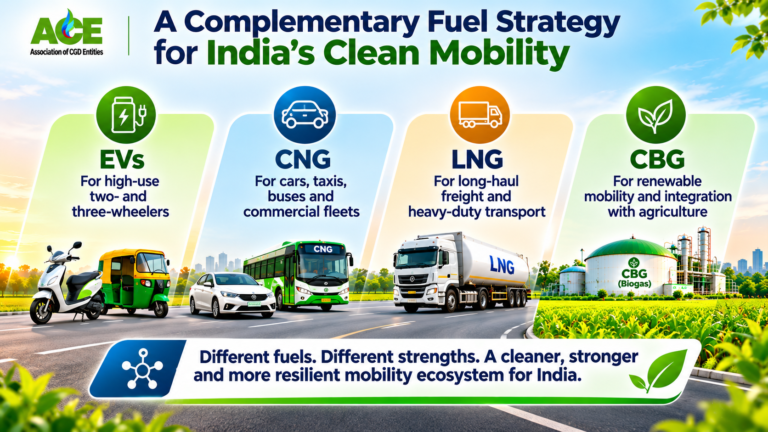
India needs a diversified mobility strategy that leverages different technologies according to their strengths:
EVs: High-use two- and three-wheelers.
CNG: Cars, taxis, buses and commercial fleets.
LNG: Long-haul freight and heavy-duty transport.
CBG: Renewable mobility and integration of agriculture with the gas network.
Each technology has a complementary role in India’s transition towards cleaner transportation.
Realising India’s CBG potential requires a supportive policy and commercial ecosystem, including:
Reliable agricultural biomass supply chains.
Assured offtake and long-term market access.
Strong demand for fermented organic manure.
Progressive CBG blending obligations beyond the notified 5% towards the 20% potential highlighted by TERI.
Greater investment in production and distribution infrastructure.
The City Gas Distribution (CGD) sector can play a pivotal role by leveraging existing pipelines, CNG stations and distribution networks to facilitate renewable gas adoption.
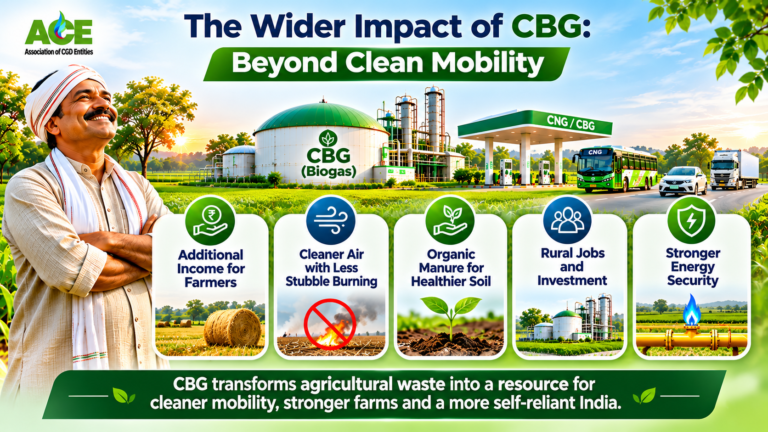
CBG represents an opportunity to transform agricultural waste into wealth while supporting cleaner mobility, rural prosperity and domestic energy security.
As highlighted by Mr. Subhash Kumar, India’s clean mobility transition should not be about choosing between EVs, CNG and CBG, but about creating an integrated ecosystem where every technology contributes effectively.
The future of clean mobility lies in connecting India’s farms, energy infrastructure and transportation ecosystem.
The Association of CGD Entities (ACE) remains committed to supporting the growth of the CGD sector and accelerating India’s transition towards cleaner and more sustainable energy solutions.